

Talk about the story in your own language
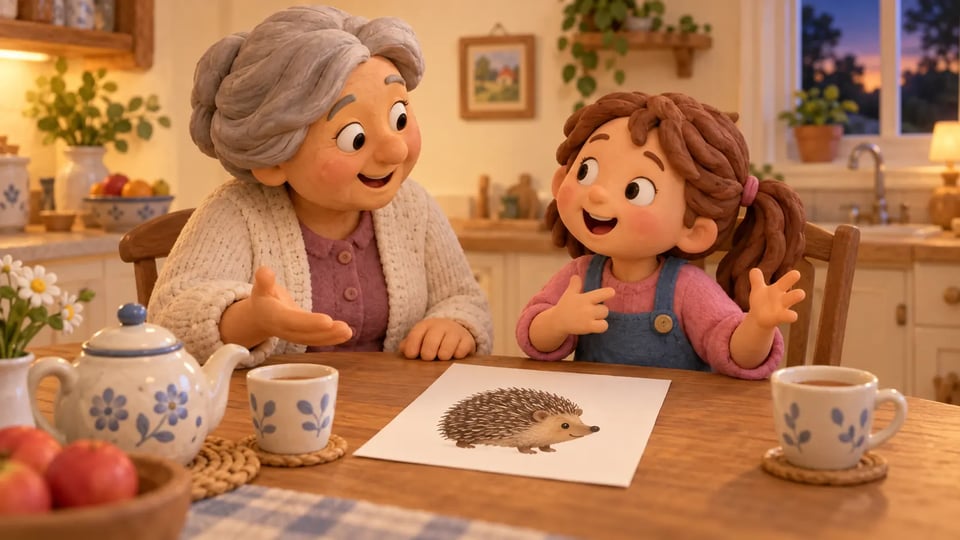
At the end of every story and picture book there is a card for you, the grown-up, in the language you use at home: a few questions to ask your child, and some key English words to say together, with their sound. You do not need confident English to use it, which is rather the point.
Why your own language
The research is on your side. When preschool children learning English took storybooks home in their family's own language, Hmong or Spanish, they learnt at least as many English words as children who took books home in English (Roberts, 2008). Those children were younger than most of ours, so expect a smaller effect at ten, but the idea holds: a child who understands a story in one language needs only the English words for it. Our guide on whether reading aloud helps says the same of reading in your own language.
When researchers followed Chinese families reading English e-books with their five- and six-year-olds, every parent used Chinese to explain and to talk, and most said they felt overwhelmed by having to juggle many kinds of questions and prompts at once. The authors suggest that story apps build the prompts in (Zhao, Cai and Qin, 2026). So the card keeps to a few.
What is on the card
- A few questions to ask your child. They go from what happened, to how someone felt or why, to your child's own life. They are open: there is no answer to check, so you need no English to ask them, and your child does the talking.
- Some key English words to say together. Tap a word to hear it, then say it together. Each comes with its meaning in your language.
- Your language. The card opens in the language you read the site in, or the one you chose for word meanings, and you can change it on the card.
What we left off
A summary. The first cards carried one, and we took it out: a child who could read the story in their home language would, and the English is the point. The card gives you a way into the story without retelling it, and the story itself stays in English. There is nothing to fill in and no score. The answers stay at the table.
The hard part: every language right
So each card is translated with the story's own blurb in that language beside it, and a hedgehog stays the hedgehog the blurb already calls him. Family words are translated, even when a story uses them as names. A question to your child suits a girl or a boy. Every translation is checked before it goes up, and a doubtful word is looked up before it stays.
Print it
On a library story, Print or save as PDF sits beside the card. The story comes out on two pages: the story, then the card in your language, with a QR code that opens it online to hear it read aloud. Screens are for practice, so at bedtime read it printed, and put every screen away, ours included.
One more thing: ask the question, then wait. The answer usually arrives in the pause you were about to fill.
The StorySparkle team