

Newsletter
Stories set where your child lives
Published on 10/24/2026
3 min read
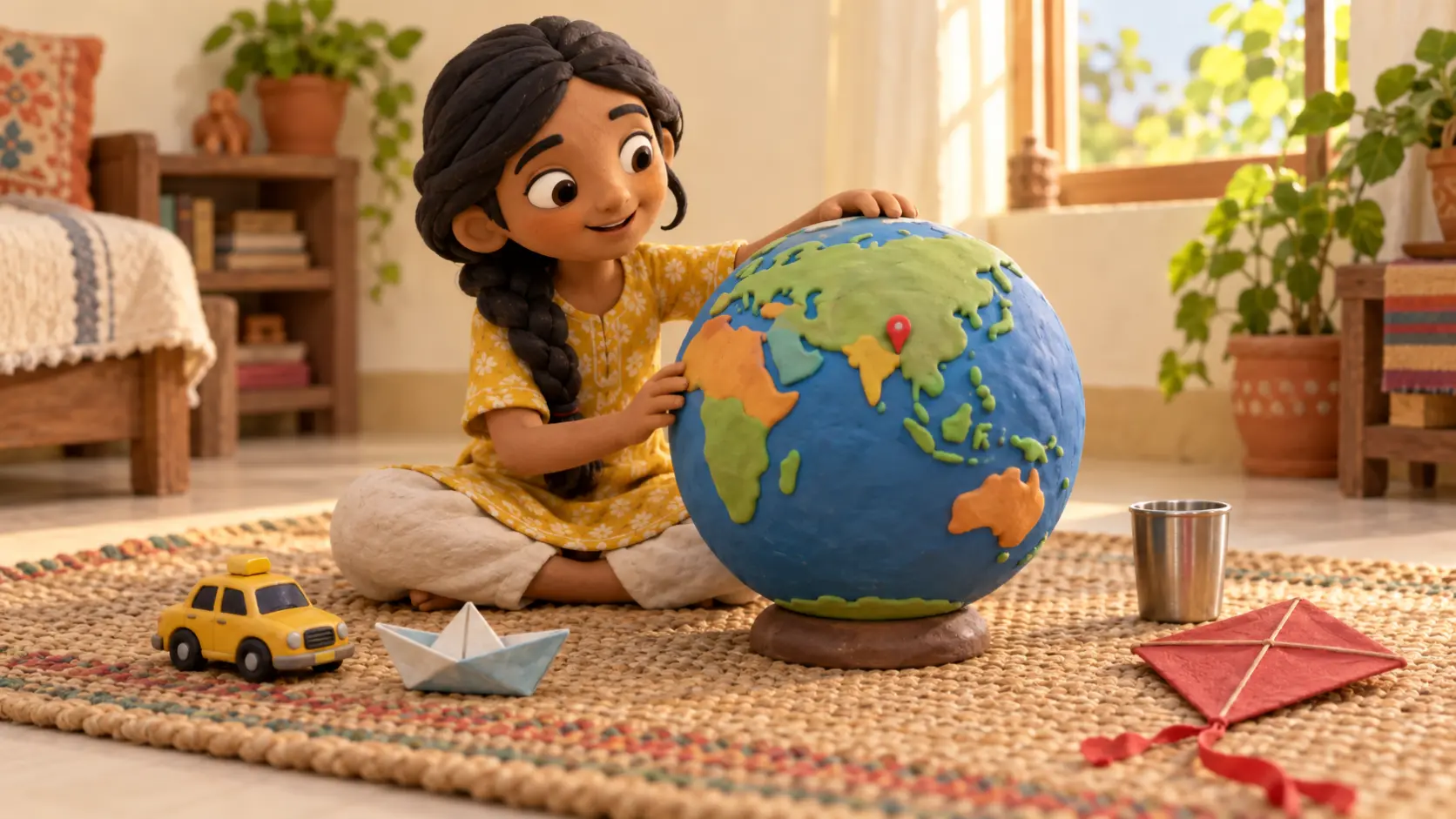
The Story Maker can set a story in your child's own town, or in any town on Earth. Spin a clay globe and tap a city, or type a town's name: in English, by an old name (Calcutta, Saigon) or in your own script (ঢাকা, กรุงเทพ). The hero is a girl or a boy who lives there, and the story is full of things they know from home. Watch how it works.
Treasures, and their English words
For every place, we find the things a child there knows: food, festivals, clothes, the way people get around. Your child picks their favourite treasures for the story. Each card shows the child's own word, with the English word under it: a Bengali reader who picks Kolkata sees ইলিশ মাছের ঝোল, and beneath it, hilsa fish curry. The story is always in English, at the child's CEFR level, from A1 (beginner) to B2 (upper-intermediate). That is the point: the English word for something they already know from home. Our guide explains why that helps.
What AI gets wrong about a place
An AI writer knows a great deal about a city and very little about a child's day in it. Left to itself, it reaches for the same few ideas; finding them took many test stories.
The first was the plot. When the hero was a local animal, story after story came out the same: something falls, and the animal fetches it back. So the hero is a person who lives there, and the trouble comes from life there: the weather, a job, a family's day.
The second was the everyday moments a story can start from. At first every place got the same ones: helping to cook, waiting for a festival, children playing after school. So each moment has to belong to its own place. In Kolkata, a girl rides the clanging tram to her grandmother's house. In London, a girl sits at the very front of the top deck of a red bus, which any London child will tell you is the only seat.
Why there are no puffins in London
A child can add one local animal to the story, as part of the place and never talking. Our first list was drawn up region by region, and a region is big: it offered London a puffin, a bird of northern sea cliffs, and Chennai a leopard.
So each place's research finds its own: animals a child could see there or on a day trip, such as a fox in a London garden or an olive ridley turtle on a Chennai beach, or that families there keep. Zoos do not count. Then we checked them against GBIF, the open international record of wildlife sightings, looking for each animal near its town. The animals hardly ever seen there all but disappeared. One that still looks odd is the axolotl, offered for Mexico City: nearly gone in the wild, but still living in the city's canals.
So each place's research finds its own: animals a child could see there or on a day trip, such as a fox in a London garden or an olive ridley turtle on a Chennai beach, or that families there keep. Zoos do not count. Then we checked them against GBIF, the open international record of wildlife sightings, looking for each animal near its town. The animals hardly ever seen there all but disappeared. One that still looks odd is the axolotl, offered for Mexico City: nearly gone in the wild, but still living in the city's canals.
What we held back
We also built Long Ago, for stories set in history, and switched it off. A period of history can bring a culture's hardest chapter into a bedtime story and start an argument no child needs. And dynasties are the school's job, not ours.
The make-believe worlds had the same care, so that any family, anywhere, can share them: no ghosts, no real gods or shrines, and no wild animals made to perform.
The make-believe worlds had the same care, so that any family, anywhere, can share them: no ghosts, no real gods or shrines, and no wild animals made to perform.
The limits, plainly
- Real Places needs a free account. Signed out, you can spin the globe; opening a place asks you to join.
- New places are limited each month. A place nobody has picked before uses one, and so does a town we cannot find; subscribers get more. A place someone has opened before is free, in every language.
- Each story is a Story Maker story, like any other, and subscribers can make more.
- The research is careful, not perfect. If something is wrong for your town, tell us at support@storysparkle.org.
Every story you make can become a picture book to print at home. Start with your own town. Then try the one where a grandparent lives.