


Does reading aloud to your child actually help?
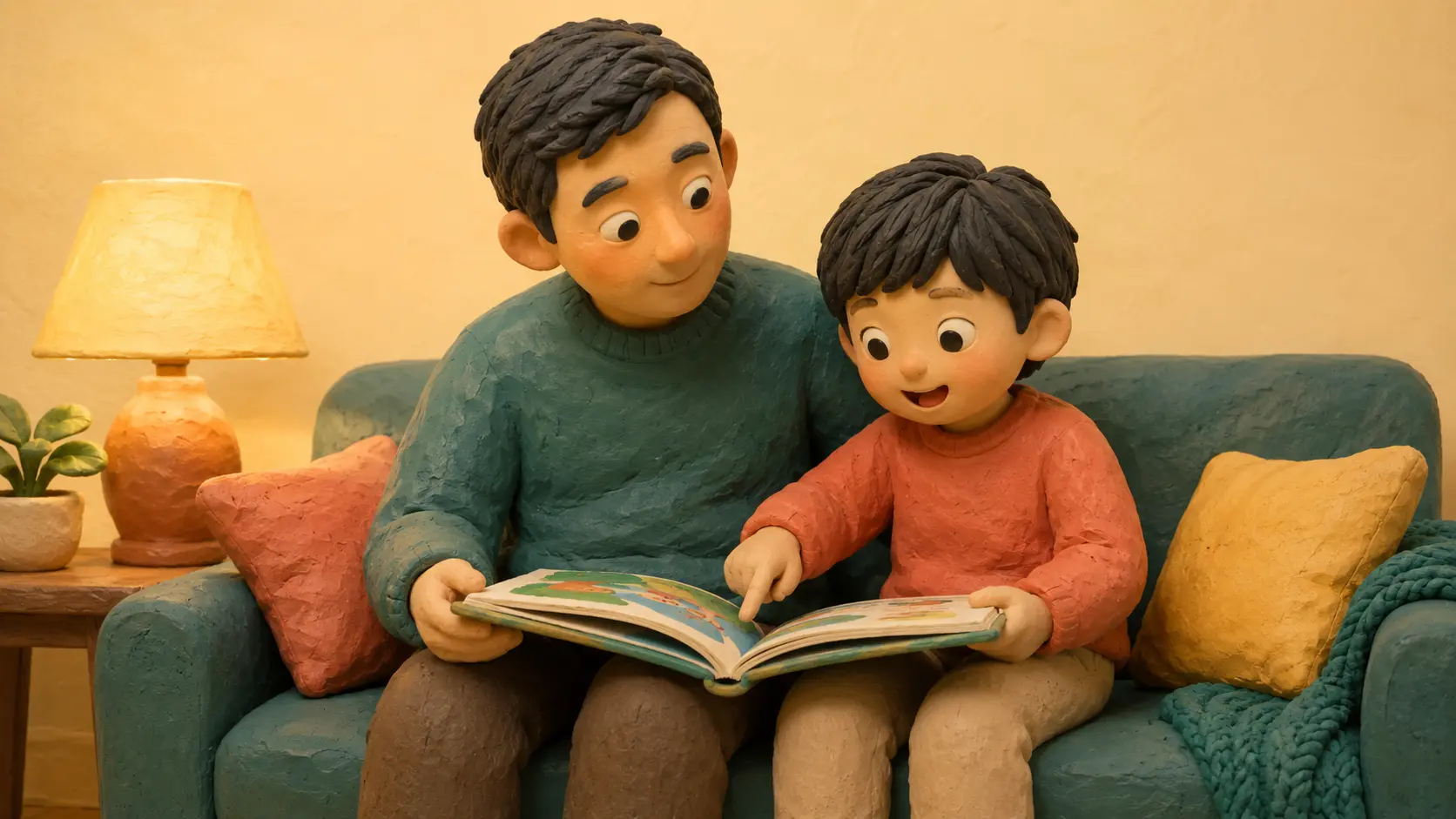
Most parents already suspect that reading aloud is good for their child. What they actually want to know is whether it is worth doing on the evenings when everybody is tired, whether it still counts once the child can read by themselves, and whether it has to be in English. The answers are yes, yes and no. The reasons are more interesting than the answers.
What the evidence actually says
Reading advice is a field where confidence usually outruns evidence. Shared reading is the exception. It is one of the few things almost everyone who studies reading agrees on.
It is worth knowing what that number is: a projection built from 60 commonly read picture books, not a tally of real households. The authors say as much themselves. But the scale of the gap survives any reasonable quibble about the method.
Why it does more for a child learning English
Grøver, Rydland, Gustafsson and Snow (2020) ran a trial across 60 preschools, 123 classrooms and 464 children who were learning a second language. Whole classrooms were assigned at random either to the new approach or to carrying on as usual, which is about as close as education research gets to the way a medicine is tested. Classrooms using structured shared book reading showed a substantial gain in second-language vocabulary, plus smaller gains in grammar and in the ability to take somebody else's perspective.
To put the size of that in ordinary terms: the average child in those classrooms ended up ahead of roughly three-quarters of the children who carried on as normal. In education research, where most things barely move the needle at all, that is a big result.
The mechanism is not mysterious. Books use words that conversation does not. Nobody says reluctantly or enormous while getting shoes on in the hallway.
Reading in your own language still counts
In that same trial, the home component — families reading and talking about the same themes in their own language — improved first-language vocabulary and fed indirectly into second-language learning. Concepts do not have to be learned twice. A child who already understands what a harvest is needs the English word, not the whole idea.
So if you read more fluently, more warmly and more often in your first language, read in your first language. A confident parent reading well beats a self-conscious parent reading badly in English, every time.
What each kind of reading is for
Not all reading time does the same job, and the daily amounts are smaller than most reading logs imply.
| Activity | What it builds | Realistic daily |
|---|---|---|
| You read to them, above their level | Vocabulary, sentence patterns, appetite for stories | 15–20 min |
| They read aloud to you, below their level | Fluency, confidence, expression | About 5 min |
| They read silently | Comprehension, stamina | 5–10 min |
| You read in your home language | Concepts, closeness, first-language depth | Counts fully |
| Audiobook in the car | Vocabulary, story sense | As long as they like |
What doesn't work
- Making the reading log the point. Counting minutes turns reading into a task performed for a chart. If school sends one home, fill it in at the end of the week and call it close enough.
- Stopping once they can read. The most common mistake, and the most costly. A seven-year-old can listen to books years beyond what they can decode, which is where the interesting vocabulary lives.
- Only reading books at their level. Their reading level governs what they practise on. It should not govern what you read to them.
- Turning every page into a comprehension check. Three questions about the plot will end the session faster than anything else available to you.
When to worry, and when not to
A few things are worth mentioning to your child's teacher: if they still cannot recognise common short words like the, and or is by sight at the end of their second year of school; if they consistently confuse letters that look alike (b/d, p/q) well past the start of the year; if they get headaches or sore eyes from short stretches of reading; or if they avoid text the way other children avoid the dentist.
None of these is an emergency. They just mean somebody with more eyes on it should take a look. For children learning English, also remember that a quiet period in a new language is normal and is not the same thing as a reading difficulty.
A small note on StorySparkle
What we are not is a substitute for the fifteen minutes described above. We cannot sit on the sofa. If you have a library card, a willing adult and a pile of picture books, you already have the thing that matters most, and you do not need us for it.
If it is useful, our guide to literacy development from 3 to 12 covers the skills underneath all this, and reading by theme is a different way to choose what comes next. Our levelled library is sorted by difficulty when you need something tonight.
One last thing
Fifteen unglamorous minutes, most nights, in whichever language you are most yourself in. That is the whole intervention. It outperforms nearly everything sold to parents as an improvement on it, including the things sold by us.
About the author
Updated August 2026. Every study linked here was checked at the time of writing.