

Reading Tips
Literacy Development
Why reading-level scores get children’s books wrong
Published on 10/21/2026
6 min read
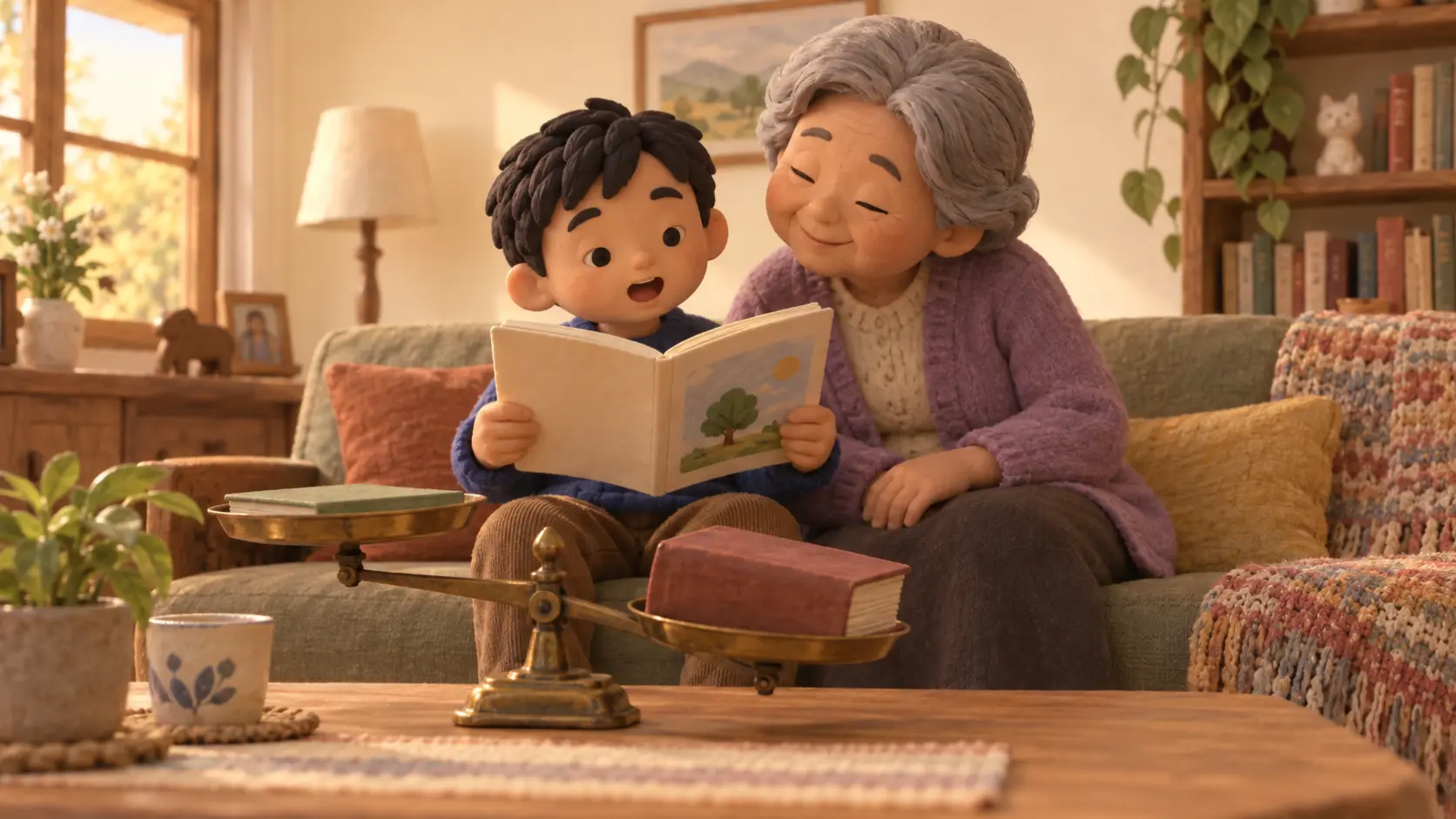
The book says Level 3, or Ages 7–9, or an app gives it a grade. Your child either finishes it in ten minutes or sits staring at page two. Usually the number is wrong, and wrong in a way you can predict.
A reading-level score counts two things
Rudolf Flesch's Reading Ease formula, published in 1948, scores a text from two counts: words per sentence and syllables per word. More of either means harder. The widely used grade-level version, Flesch–Kincaid, was recalculated in 1975 for the US Navy, from 531 enlisted sailors reading training manuals. Sensible for the Navy; not quite your question.
It gives a US school grade: add five or six for a rough age, so grade 2 means seven or eight.
Rebekah George Benjamin's 2012 review found hundreds of these formulas, argued over for decades, largely for letting surface counts stand in for what happens in a reader's head.
It gives a US school grade: add five or six for a rough age, so grade 2 means seven or eight.
Rebekah George Benjamin's 2012 review found hundreds of these formulas, argued over for decades, largely for letting surface counts stand in for what happens in a reader's head.
Good stories fool it most
The US Common Core standards say so plainly in their appendix on text complexity: long words and long sentences are not hard in themselves, and short, plain sentences can be harder, because they lose joining words such as because and so.
Their own example: Flesch–Kincaid and the Lexile scale both rate The Grapes of Wrath, a Pulitzer Prize-winning novel the standards place with 14- to 16-year-olds, as right for grades 2–3. Plain words, heavy themes, much left unsaid: a fair description of a good children's story too.
Their own example: Flesch–Kincaid and the Lexile scale both rate The Grapes of Wrath, a Pulitzer Prize-winning novel the standards place with 14- to 16-year-olds, as right for grades 2–3. Plain words, heavy themes, much left unsaid: a fair description of a good children's story too.
| What a formula counts | What it misses | A sentence that fools it |
|---|---|---|
| Words per sentence | What the words leave unsaid, for the reader to work out | “She opened her mouth to argue, then closed it.” Scores as grade 2. Why did she stop? The sentence never says. |
| Syllables per word | Short words that mean something together that they do not mean apart | “They put the fire out and set off.” Scores below grade 1. A child new to English may picture someone carrying a fire outside. |
| Syllables per word, the other way round | Long words a child already knows | “Everybody was celebrating Grandmother’s birthday.” Scores beyond grade 12, the top of the school scale, without a hard word in it. |
| Words per sentence, again | How a sentence is built: one idea tucked inside another | “The cake that the girl who lived next door made was gone.” Twelve one-syllable words; scores as grade 1. The reader has to hold on to “the cake” for eight words. |
| Nothing about the reader | What the child already knows | “He was out for a duck.” Scores below grade 1. Obvious to a child who follows cricket; nonsense to one who doesn’t. |
We made the same mistake with our own books
This is our own data. The Horn on the Ridge, a picture book in our gallery, was written at CEFR level B2. CEFR is the European scale of language levels, from A1 for beginners to C2, and we write B2 for readers of about 12 to 15. The book’s difficulty is in what it leaves out: a girl who pretends not to hear her mother, guards who take a salute for a challenge.
Flesch–Kincaid puts it at grade 2 to 3, the band it gives The Grapes of Wrath, and level with a gallery book we wrote for seven- to nine-year-olds.
Our own scorer was fooled too. SESL©, our measure of how hard English is for a child reading it as a second language, rated it ‘Easy’ until October 2026: it looked for named feelings and words like perhaps, and this book shows rather than names. We added measures for what a reader must work out, scored every story in our library and gallery with the old and new versions, and read by hand every sentence the new measures picked out. The book now lands nearest its own level.
It is not fully fixed. When we wrote one short story at each level from A1 to B2, its score rose at every step until B2, where it fell back below B1, in every rewrite we tried. Flesch–Kincaid dipped there too. And from B1 to B2 the sentences in our stories barely get longer: the step up is in what is left unsaid.
In fairness, across our gallery the formula got the order of the levels roughly right. It goes wrong one book at a time.
What a score is still good for
A score is a fair first sort across a shelf and a poor verdict on one book. The Common Core appendix makes the number one of three equal parts, alongside a careful read by a person and the particular reader, and says someone reading the book should confirm or overrule it. No formula knows the reader: what they have read, which language they grew up speaking, whether the story is set somewhere they know, or whether they follow cricket.
Check the book by ear in two minutes
- Ask them to read a page from the middle aloud. Don’t correct; notice where they stop, guess or go back.
- Close the book and ask what happened, in whichever language comes easiest. You are checking understanding, not spoken English.
- Ask one ‘why’ the page doesn’t answer outright. Why did she close her mouth? This is the part no formula can check.
Then:
- Smooth, and they can say what happened and why: it is theirs to read alone.
- Smooth, but they can’t say what happened: the words are fine and the meaning is not. Read it together and talk as you go. Our guide to what develops when explains why.
- So many stops that the sentences fall apart: keep it for reading aloud to them, and try again in a few months.
What doesn't work
- Trusting the number over your child. A label is a guess about an average reader. You have the actual one.
- Chopping sentences to make a text ‘easier’. It lowers the score and can make the reading harder, because the joining words go first. A text does not get easier because a formula has been persuaded that it has. Writing to formulas is one of the two main complaints in Benjamin’s review.
- Taking a book away because of its level. The Common Core appendix notes that motivated readers put in extra effort for a story they care about. Read it together instead.
When to worry, and when not to
A child learning English will find many books for their age hard in English. That is expected, and reading closes the gap.
Tell their teacher if they also struggle with easy books in their stronger language, or if the trouble is reading the words rather than knowing what they mean. Not in a panic. Just so someone with more eyes on it can have a look. Our dyslexia guide explains the difference.
Tell their teacher if they also struggle with easy books in their stronger language, or if the trouble is reading the words rather than knowing what they mean. Not in a panic. Just so someone with more eyes on it can have a look. Our dyslexia guide explains the difference.
Questions parents ask
Are reading-level scores accurate?
Roughly, on average, but often wrong about one book: plain words carrying hard ideas score too easy.
How can I tell if a book is the right level for my child?
Have them read a page from the middle aloud, then tell you what happened and why. If they can do both, it is right for reading alone.
Do reading levels work for children learning English?
Less well. A formula knows nothing about the reader, so check by ear, and let your child retell the story in their easiest language.
A small note on StorySparkle
Our free reading level checker measures far more than sentence and word length. Paste a passage or photograph a page, and it gives a SESL© score, a rough CEFR band, and skill bars for vocabulary, sentence complexity, story understanding and reading flow. The same text always gets the same score and the same verdict. It is free with an account.
What it cannot do is hear your child read, or know what they already know. So use it to sort a pile of worksheets or library books quickly, then check the ones that matter by ear.
What it cannot do is hear your child read, or know what they already know. So use it to sort a pile of worksheets or library books quickly, then check the ones that matter by ear.
One last thing
A reading-level score is a guess about an average child, made by counting. You have the actual child and two minutes. That is the better test.
About the author
Written by StorySparkle’s reading team — a group that includes qualified English language teachers and a specialist in second-language reading assessment, and which built the SESL© levelling scale behind our library. We write for families raising readers in more than one language.
Updated October 2026. Every study linked here was checked at the time of writing.
Updated October 2026. Every study linked here was checked at the time of writing.