

Online Stories
Interactive Learning
Creative Writing
AI Story Generation
Literacy Development
Education Technology
Featured
How to help a five-year-old write their first story
Published on 8/31/2025
6 min read
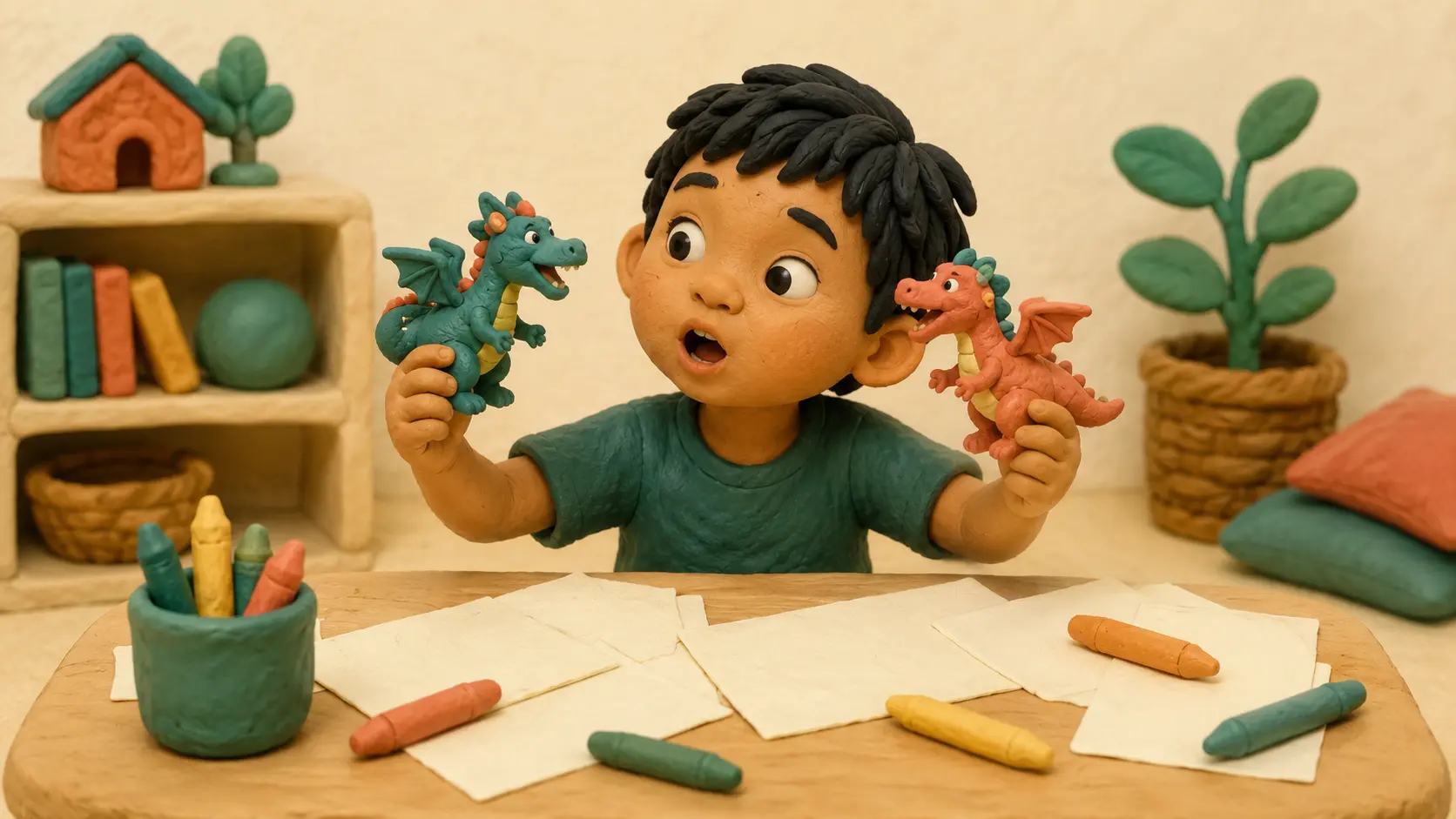
The blank page is worse at five than at any other age. The child has a story in their head, and between it and the paper sit two obstacles most adults have forgotten about: they cannot yet spell the words, and their hand gets tired after a line. Almost everything that helps is about getting those two out of the way.
Let them spell it wrong, on purpose
This is the piece of advice that makes parents most uncomfortable, so it is worth the evidence.
When a child writes MSTR for monster, they are doing something genuinely difficult: holding a word in mind, breaking it into sounds, and finding a letter for each one. That is the same machinery reading runs on, operated in reverse.
Ouellette and Sénéchal (2017) followed 171 children through their first year of school. How sophisticated a child's invented spelling was in kindergarten predicted how well they read and spelled a year later. The fear that letting children invent spellings will cement bad habits turned out to be backwards.
So when your child asks how to spell something, the most useful answer is usually not the answer. It is have a go.
When a child writes MSTR for monster, they are doing something genuinely difficult: holding a word in mind, breaking it into sounds, and finding a letter for each one. That is the same machinery reading runs on, operated in reverse.
Ouellette and Sénéchal (2017) followed 171 children through their first year of school. How sophisticated a child's invented spelling was in kindergarten predicted how well they read and spelled a year later. The fear that letting children invent spellings will cement bad habits turned out to be backwards.
So when your child asks how to spell something, the most useful answer is usually not the answer. It is have a go.
Writing feeds reading, not the other way round
Writing is usually treated as the thing that comes after reading. The evidence suggests the traffic runs both ways.
Graham and Hebert (2011) pulled together the results of 95 separate studies and found that teaching children to write improved their reading comprehension, their fluency and their word reading, and that simply writing more improved comprehension on its own.
For a child learning English this matters more than usual. Writing forces production, and production exposes the gaps that reading lets you skate over. A child can read the word because for a year without ever noticing how it is built. They notice the first time they try to write it.
Graham and Hebert (2011) pulled together the results of 95 separate studies and found that teaching children to write improved their reading comprehension, their fluency and their word reading, and that simply writing more improved comprehension on its own.
For a child learning English this matters more than usual. Writing forces production, and production exposes the gaps that reading lets you skate over. A child can read the word because for a year without ever noticing how it is built. They notice the first time they try to write it.
Take the obstacles away one at a time
A five-year-old is doing four jobs at once — inventing, remembering, spelling and handwriting — and any one of them can sink the whole thing. Remove whichever is in the way.
Letting them tell it aloud before anything is written down is not a shortcut, incidentally. The EEF rates communication and language approaches at around six additional months of progress in the early years, on extensive evidence. Talking the story through is the lesson; the writing is what happens to it afterwards.
Letting them tell it aloud before anything is written down is not a shortcut, incidentally. The EEF rates communication and language approaches at around six additional months of progress in the early years, on extensive evidence. Talking the story through is the lesson; the writing is what happens to it afterwards.
| What you see | What is usually underneath | What helps |
|---|---|---|
| Blank page, no ideas | Too much choice | Give two options, not an open field |
| Starts, then gives up | Hand tired, not interest lost | You write, they dictate |
| Asks how to spell every word | Afraid of getting it wrong | “Write the sounds you hear” |
| Story runs on forever | No sense of an ending | Ask what the last picture would be |
| Refuses outright | It has become schoolwork | Do it out loud, write nothing |
What doesn't work
- Correcting the spelling as they go. Nothing stops a five-year-old writing faster. Fix it later, or not at all, depending on why they were writing.
- Asking for a whole story. Three sentences is a story at this age. A beginning and a surprise will do.
- Story starters they did not choose. A prompt about a magic tree is only useful to a child interested in trees. Their obsession is the better prompt, however narrow it is.
- Insisting on the writing part. A child who dictates a story while you scribe is still composing, which is the skill that matters. The handwriting will catch up on its own schedule.
When to worry, and when not to
Wildly variable handwriting, reversed letters and inventive spelling are all ordinary at five and stay ordinary for a while. Reversed b and d well past six is worth a mention; at five it is just five.
Worth raising with the teacher: if a child cannot hear the first sound in a spoken word by the end of their first school year; if they cannot hold a pencil comfortably after plenty of practice; or if writing produces real distress rather than ordinary reluctance.
For bilingual children, expect the story in English to be simpler than the story in their head. That gap is not a writing problem, it is a vocabulary one, and it closes. If they want to write part of it in their home language, let them. The composing is the same skill in either language.
Worth raising with the teacher: if a child cannot hear the first sound in a spoken word by the end of their first school year; if they cannot hold a pencil comfortably after plenty of practice; or if writing produces real distress rather than ordinary reluctance.
For bilingual children, expect the story in English to be simpler than the story in their head. That gap is not a writing problem, it is a vocabulary one, and it closes. If they want to write part of it in their home language, let them. The composing is the same skill in either language.
A small note on StorySparkle
Our Story Maker takes the mechanical obstacles out: the child chooses a character, a world and a problem, and gets a finished illustrated story back without having to spell or handwrite any of it. For a child whose ideas outrun their pencil, that is a real unlock.
It is also not writing practice, and we should not pretend otherwise. It builds composition — deciding what happens and to whom — and leaves spelling and handwriting entirely alone. Those still need a pencil, some paper and somebody willing to accept KAT.
You can try Story Maker, or start from the reading side instead with our levelled library. If you want the wider picture of what develops when, our guide to reading skills from 3 to 12 covers it, and reading together is still what feeds the ideas in the first place.
It is also not writing practice, and we should not pretend otherwise. It builds composition — deciding what happens and to whom — and leaves spelling and handwriting entirely alone. Those still need a pencil, some paper and somebody willing to accept KAT.
You can try Story Maker, or start from the reading side instead with our levelled library. If you want the wider picture of what develops when, our guide to reading skills from 3 to 12 covers it, and reading together is still what feeds the ideas in the first place.
One last thing
Three sentences, spelled however they come out, about whatever your child is currently obsessed with. Read it back to them as though it were a real book, because to them it is. That is the entire exercise, and the spelling sorts itself out later.
About the author
Written by StorySparkle's reading team — a group that includes qualified English language teachers and a specialist in second-language reading assessment, and which built the SESL© levelling scale behind our library. We write for families raising readers in more than one language.
Updated August 2026. Every study linked here was checked at the time of writing.
Updated August 2026. Every study linked here was checked at the time of writing.