

Does reading aloud to your child actually help?
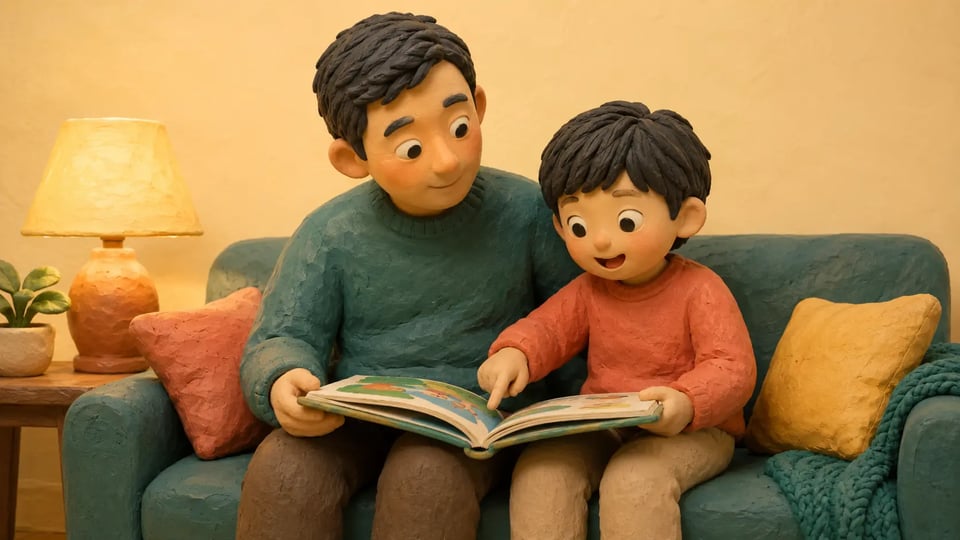
Most parents already suspect that reading aloud is good for their child. What they actually want to know is whether it is worth doing on the evenings when everybody is tired, whether it still counts once the child can read by themselves, and whether it has to be in English. The answers are yes, yes and no. The reasons are more interesting than the answers.
What the evidence actually says
Reading advice is a field where confidence usually outruns evidence. Shared reading is the exception. It is one of the few things almost everyone who studies reading agrees on.
It is worth knowing what that number is: a projection built from 60 commonly read picture books, not a tally of real households. The authors say as much themselves. But the scale of the gap survives any reasonable quibble about the method.
Whether the pictures in those books help as well, or get in the way, is a separate question: do picture books help children learning English?
Why it does more for a child learning English
Grøver, Rydland, Gustafsson and Snow (2020) ran a trial across 60 preschools, 123 classrooms and 464 children who were learning a second language. Whole classrooms were assigned at random either to the new approach or to carrying on as usual, which is about as close as education research gets to the way a medicine is tested. Classrooms using structured shared book reading showed a substantial gain in second-language vocabulary, plus smaller gains in grammar and in the ability to take somebody else's perspective.
To put the size of that in ordinary terms: the average child in those classrooms ended up ahead of roughly three-quarters of the children who carried on as normal. In education research, where most things barely move the needle at all, that is a big result.
The mechanism is not mysterious. Books use words that conversation does not. Nobody says reluctantly or enormous while getting shoes on in the hallway.
Reading in your own language still counts
In that same trial, the home component — families reading and talking about the same themes in their own language — improved first-language vocabulary and fed indirectly into second-language learning. Concepts do not have to be learned twice. A child who already understands what a harvest is needs the English word, not the whole idea. It is also why stories set where your child lives are easier to follow in English: when the world is already known, only the language is new.
So if you read more fluently, more warmly and more often in your first language, read in your first language. A confident parent reading well beats a self-conscious parent reading badly in English, every time.
What each kind of reading is for
Not all reading time does the same job, and the daily amounts are smaller than most reading logs imply.
| Activity | What it builds | Realistic daily |
|---|---|---|
| You read to them, above their level | Vocabulary, sentence patterns, appetite for stories | 15–20 min |
| They read aloud to you, below their level | Fluency, confidence, expression | About 5 min |
| They read silently | Comprehension, stamina | 5–10 min |
| You read in your home language | Concepts, closeness, first-language depth | Counts fully |
| Audiobook in the car | Vocabulary, story sense | As long as they like |
What doesn't work
- Making the reading log the point. Counting minutes turns reading into a task performed for a chart. If school sends one home, fill it in at the end of the week and call it close enough.
- Stopping once they can read. The most common mistake, and the most costly. A seven-year-old can listen to books years beyond what they can decode, which is where the interesting vocabulary lives.
- Only reading books at their level. Their reading level governs what they practise on. It should not govern what you read to them.
- Turning every page into a comprehension check. Three questions about the plot will end the session faster than anything else available to you.
When to worry, and when not to
A few things are worth mentioning to your child's teacher: if they still cannot recognise common short words like the, and or is by sight at the end of their second year of school; if they consistently confuse letters that look alike (b/d, p/q) well past the start of the year; if they get headaches or sore eyes from short stretches of reading; or if they avoid text the way other children avoid the dentist.
None of these is an emergency. They just mean somebody with more eyes on it should take a look. For children learning English, also remember that a quiet period in a new language is normal and is not the same thing as a reading difficulty.
Questions parents ask
Does reading aloud to my child really help?
Yes, and the evidence is unusually strong for education research. One study estimated that, in the five years before school, a child from a book-heavy home hears about 1.4 million more words in storybooks than a child who is never read to.
How long should I read to my child each day?
About fifteen to twenty minutes of you reading to them, most nights, is enough. Choose books above the level they can read alone: their reading level is for their own practice, not for what you read to them.
Should I keep reading to my child once they can read on their own?
Yes. Stopping once a child can read alone is the most common mistake, because that is when reading aloud starts paying off most. A seven-year-old can listen to books years beyond what they can read themselves, and that is where the interesting words are.
Does reading aloud help a child who is learning English?
Yes, and it is one of the few things in this area tested in a proper trial. Preschool classrooms that used structured shared book reading saw a substantial gain in children's vocabulary in their second language, because books use words that everyday talk does not.
Does reading to my child in our home language help their English?
Yes. A child who already understands an idea in their home language only needs the English word for it, not the whole idea again. If you read more fluently and warmly in your first language, read in your first language.
A small note on StorySparkle
What we are not is a substitute for the fifteen minutes described above. We cannot sit on the sofa.
If it is useful, our guide to literacy development from 3 to 12 covers the skills underneath all this, and reading by theme is a different way to choose what comes next. Our levelled library is sorted by difficulty when you need something tonight.
One last thing
Fifteen unglamorous minutes, most nights, in whichever language you are most yourself in. That is the whole intervention. Nothing sold to parents replaces it.
About the author
Updated August 2026. Every study linked here was checked at the time of writing.