

Do picture books help children learning English?
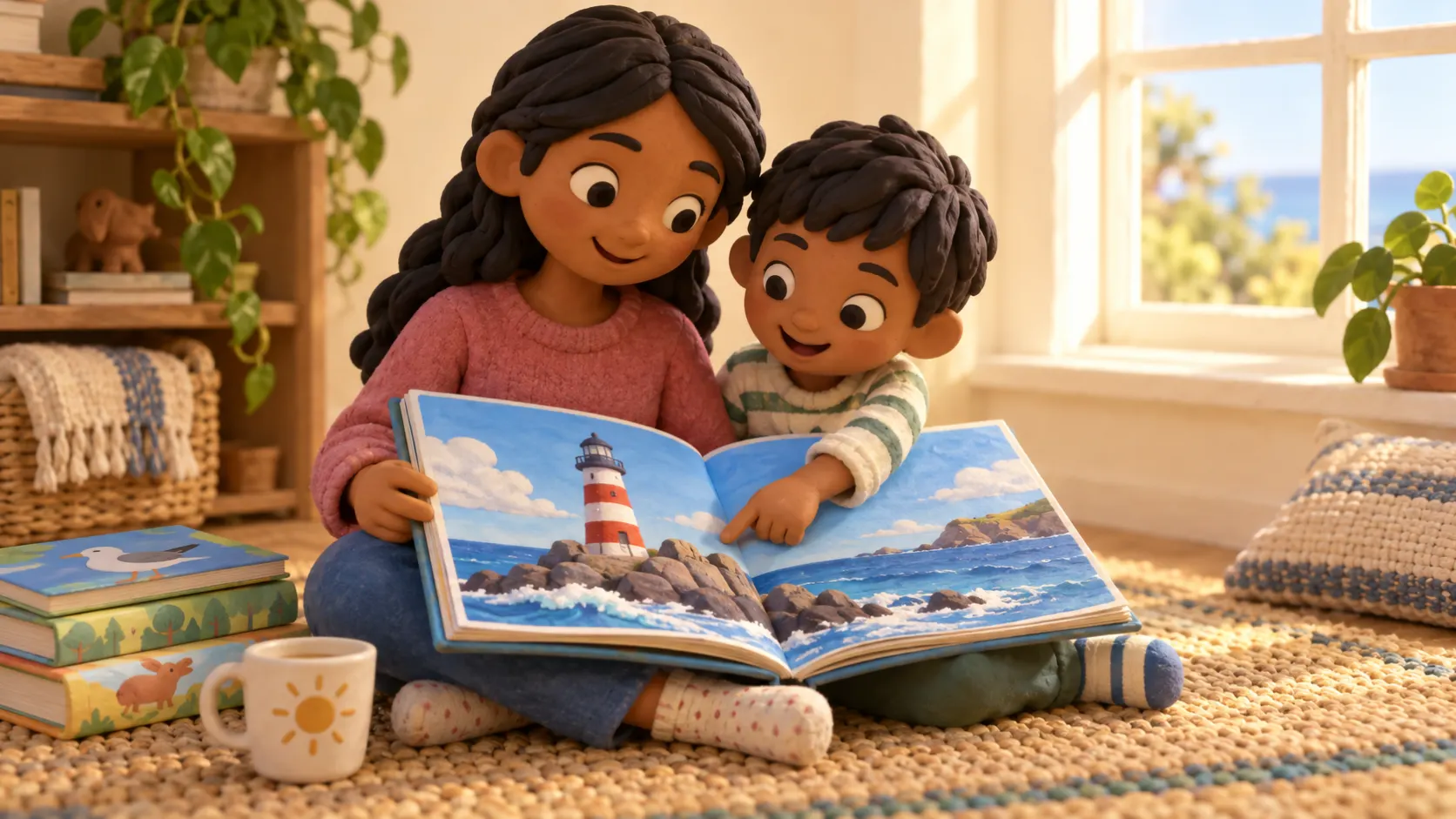
By seven or eight, picture books start to look like something a child should grow out of. A relative asks whether your nine-year-old isn't a bit old for that, and you catch your child reading the pictures instead of the words. Are the pictures helping their English, or doing the work? Both. It depends on the job.
A picture explains a word without translating it
Verhallen and Bus (2010) tested it with 92 five-year-olds from immigrant families in the Netherlands, all learning Dutch as a second language. Children who heard a picture storybook several times learned more new words than children who played a wordless computer game, and pictures that moved with the story helped most with words children could say.
Young children look at the pictures, not the words
That is no reason to read aloud less: the case for reading aloud is one of the strongest in the field. It just means a child can hear a hundred picture books and still think the story lives in the pictures. The same study found an easy fix: point to the words, run a finger under them or talk about them, and children look at the print more.
Pictures can get in the way of the words
Eng, Godwin and Fisher (2020) tested busy pages. Sixty children of about seven and a half read a real beginner's reading book twice: as published, and with the decorations that had nothing to do with the story removed. On the busy pages they looked away from the words nearly four times as often. They read the words just as accurately, but understood far less: about 47% on the questions afterwards, against about 80%.
So when you read to a child, the pictures carry meaning their English cannot carry yet. When a child reads alone, a picture that gives away the answer is competition. Read the line first, then look at the picture.
Big print is not only for little children
If your child reads on a screen, turn the text size up. Our guide to dyslexia and reading explains why extra spacing helps too.
Ten is not too old for a picture book
England's Education Endowment Foundation tested Power of Pictures, a programme built around picture books, with 2,674 Year 5 pupils, aged nine and ten, in 101 schools assigned at random to run it or not. The gain was modest: about a month of extra progress in writing, and no clear effect on reading either way. The evaluators noted that the pictures drew in children who usually struggled to join in. Not a miracle, but not a step backwards.
What a picture does at each stage
| Stage | What the picture does | What helps | Watch for |
|---|---|---|---|
| Being read to, at any age, in a new language | Shows what new English words mean, without translation | Books above their reading level; time to talk about the pictures | Eyes that never reach the print: point to a word now and then |
| Learning to read the words, in the first years of school | Can give a word away before it is read | Read the line first, then look at the picture | Guessing words from the picture instead of reading them |
| Reading alone, about seven to nine | Keeps a longer story easy to follow | Pictures that show the story; print that has not shrunk too soon | Busy, decorated pages that pull the eyes off the words |
| Nine and up, still learning English | Lets them follow a story ahead of their English | Picture books with grown-up subjects, offered without apology | Being told that picture books are babyish |
What doesn't work
- Banning pictures as cheating. The evidence is against decoration that has nothing to do with the story, not against pictures.
- Storybook apps where everything does something.Takacs, Swart and Bus (2015) pulled together 43 studies of 2,147 young children. Animation, music and sound that matched the story helped a little. Games, things to tap and pop-up dictionaries got in the way, most of all for children from less advantaged homes.
- Treating fewer pictures as a promotion. A chapter book in small print is not automatically harder, just older-looking. Check by ear whether your child can follow the words.
When to worry, and when not to
Mention it to the teacher if, after the first couple of years of school, your child can read a page with pictures but not the same words on a plain page, still guesses most words from the first letter and the picture, or avoids every book without pictures. None of this is an emergency. It just means someone with more eyes on it should take a look, and a teacher can tell whether reading or English is holding things up. Our guide to what develops when explains the difference.
Questions parents ask
Do picture books help children learning English?
Yes. Pictures show what new English words mean without translation. Point to the words as you read, so their eyes reach the print too.
Is my ten-year-old too old for picture books?
No. Pictures let an older child follow a story ahead of their English, and a large English school trial found a small gain in writing.
Can pictures get in the way of learning to read?
For a beginner reading alone, yes: busy pages pull attention off the words. Read the line first, then look at the picture.
A small note on StorySparkle
Our Picture Book Maker turns a story your child made with us into a book like that, and the first is free with an account. Our free picture-book gallery has our own, at every level from A1 to B2 on the CEFR, the European scale for language learners.
Our library stories add what paper cannot: slow, clear narration in neutral UK English Received Pronunciation, never a robotic text-to-speech, with each word lit up as it is spoken and a video narrator whose lips move with every word: the part we are proudest of.
What we are not: a phonics programme, or a printing service.
One last thing
Tonight, run your finger under one line on each page as you read. It costs nothing, and it brings their eyes to the words without taking the pictures away.
About the author
Updated October 2026. Every study linked here was checked at the time of writing.